
Stop Admiring Your Tech Debt. Start Managing It!
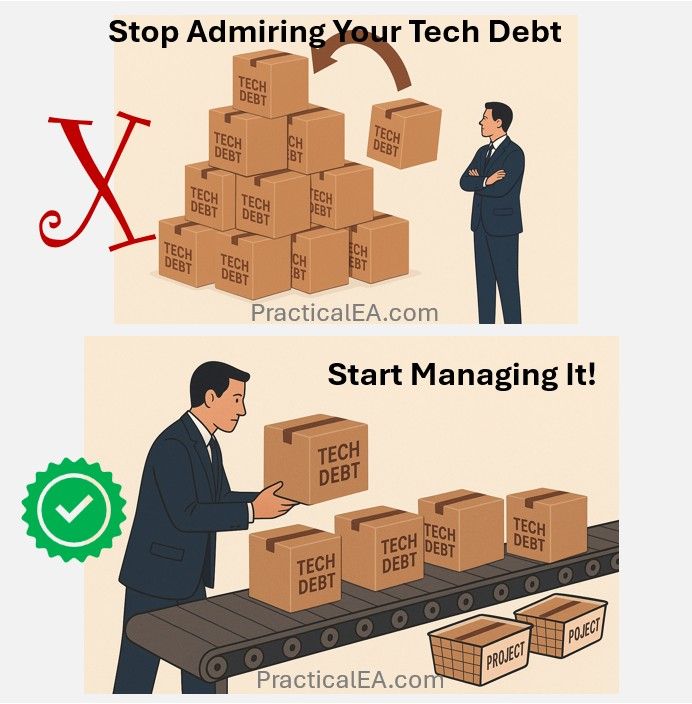
Stop Admiring Your Tech Debt. Start Managing It!
Tech Debt has been getting plenty of airtime on LinkedIn lately, some of it insightful, much of it simply repeating the mantra: “You should control your Tech Debt.”
What’s often missing is the ‘Practical how’.
Yet managing Tech Debt isn’t optional or “nice to have.” It’s the foundation for turning IT chaos into control. Left unmanaged, Tech Debt behaves like compound interest; the longer you ignore it, the faster it grows, degrading performance, stability, and your ability to deliver change.
What Tech Debt Actually Is
Definitions are everywhere, but here’s the one that matters:
“Tech Debt is the ledger of design decisions that were knowingly made to be sub-optimal, but still implemented because operational needs demanded it”.
In other words, these aren’t mistakes. They are deliberate trade-offs.
You didn’t want to make them—but the business needed a result, and “later” was the only acceptable place to park the consequences.
Design Time Is Decision Time
Real Tech Debt management doesn’t start years later in a cleanup exercise. It begins at design time.
Every time a design team accepts a known compromise, it should also create a concrete plan to retire that compromise.
These plans should be:
•Realistic: documented, costed, and scoped
•Actionable: included in future project pipelines
•Owned: assigned to teams who will implement, verify, and close them
This shifts Tech Debt from an invisible burden into a managed asset.
It Takes the Whole IT Organisation
Managing Tech Debt isn’t a task for architects alone; it’s a whole team sport.
•Project Teams must incorporate remediation work in future delivery.
•Support Teams must ensure agreed improvements are actually implemented.
•Architecture Practices must validate designs, eliminate Tech Debt where feasible, and formally initiate remediation plans where it isn’t.
When everyone owns their part, Tech Debt becomes predictable, governed, and controlled, not an accumulating surprise.
Tech Debt Isn’t a Failure. Ignoring It Is.
Most Tech Debt is operationally necessary. That’s just reality.
But letting it quietly accumulate is a choice, one that slowly erodes the health of your IT landscape.
So ask yourself:
Does your organisation truly manage Tech Debt… or does it simply admire it from a distance while hoping it won’t get worse?
PracticalEA.com is a wealth of knowledge, providing practical guidance on managing Tech Debt and many other architectural topics.